Logan Riley

CSCI 496: Senior Portfolio
In partial fulfillment of the requirements for the degree of Bachelor of Science in Applied Computing with a Concentration in Business (class of 2026)
View My Resume
View My LinkedIn Profile
Custom Map
- Class: CSCI 315 – Data Structure Analysis
- Grade: A
- Language(s): C++
- Source Code Repository: CSCI-315-2026-Spring-Solutions-
(Please email me to request access.)
Project Description
The Custom Map project was built as part of CSCI 315 – Data Structure Analysis. The goal was to implement a Map data structure from scratch in C++ — similar to how std::map works in the C++ standard library, but built entirely by hand without using any built-in containers.
The Map stores key-value pairs and supports operations like inserting new entries, retrieving values by key, removing entries, and searching for keys using binary search. Internally, the data is kept in a sorted array, which makes lookup fast and predictable.
Building the Map also required implementing proper memory management — including a copy constructor and a copy assignment operator — to make sure the data structure behaves safely when copied or assigned to another variable.
How to Compile and Run the Program
g++ -o map_test main.cpp Map.cpp
./map_test
System Output & Performance
The program runs as a command-line application. Test cases are run automatically on startup and print their results to the terminal. Output includes:
- Inserted entries — confirming key-value pairs were added successfully
- Lookup results — displaying values retrieved by key
- Remove confirmations — showing entries before and after deletion
- Edge case results — handling duplicate keys and out-of-range lookups
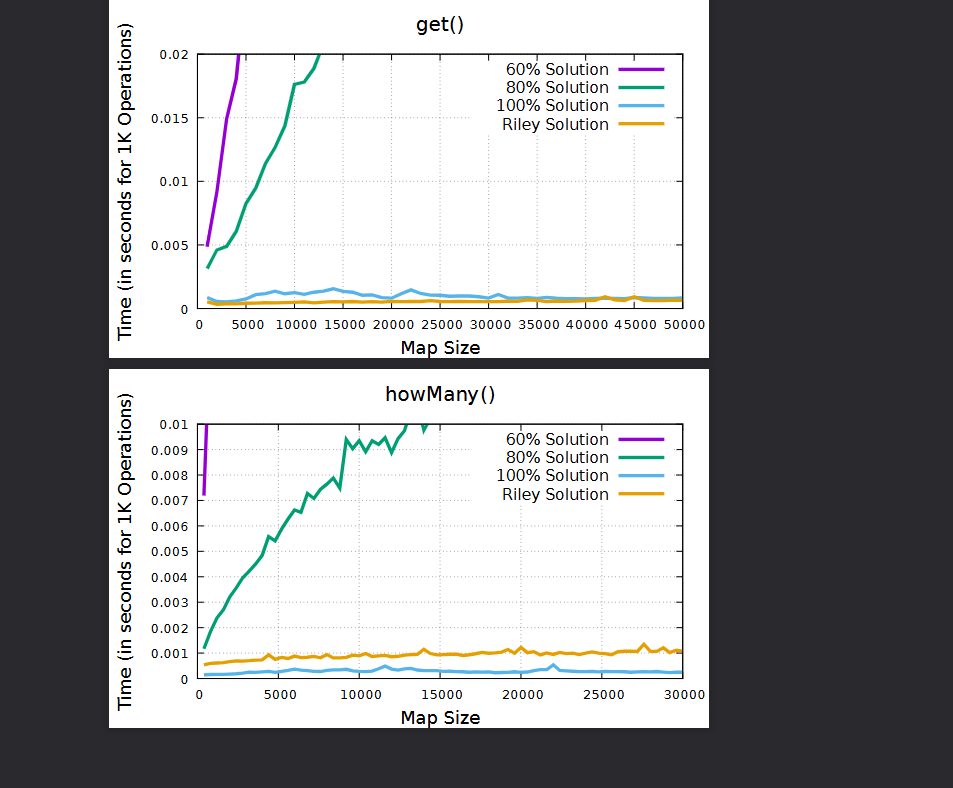
Fig. 1 — Terminal/Plot output demonstrating the performance scaling characteristics of my Custom Map against base implementations.
Code Snippets
Map.hpp — Class Definition
#ifndef MAP_HPP
#define MAP_HPP

#include <string_view>
#include <climits>
#include <string>

class Map {
public:
    Map();
    bool add(const std::string_view key, unsigned int val);
    unsigned int get(const std::string_view key) const;
    unsigned int size() const;
    unsigned int capacity() const;
    bool remove(const std::string_view key);
    unsigned int howMany(const std::string_view prefix) const;
    Map(const Map& other);
    Map& operator=(const Map& other);
    ~Map();
private:
    struct Entry {
        std::string key;
        unsigned int value;
    };
    Entry* data;
    unsigned int used;
    unsigned int alloc;
    int findInsertPos(const std::string_view key) const;
    int binarySearch(const std::string_view key) const;
    int lowerBound(const std::string_view prefix) const;
    int upperBound(const std::string_view prefix) const;
    void resize();
};
#endif
Map.cpp — Binary Search
int Map::binarySearch(const std::string_view key) const {
    int low = 0;
    int high = static_cast<int>(used) - 1;

    while (low <= high) {
        int mid = low + (high - low) / 2;
        if (data[mid].key == key)
            return mid;
        else if (data[mid].key < key)
            low = mid + 1;
        else
            high = mid - 1;
    }
    return -1;
}
Map.cpp — Insert (Sorted)
bool Map::add(const std::string_view key, unsigned int val) {
    int idx = binarySearch(key);
    if (idx != -1)
        return false;

    if (used >= alloc)
        resize();

    int insertPos = findInsertPos(key);

    for (int i = static_cast<int>(used); i > insertPos; --i) {
        data[i] = data[i - 1];
    }

    data[insertPos].key = key;
    data[insertPos].value = val;
    used++;
    return true;
}
Map.cpp — Copy Constructor & Assignment Operator
Map::Map(const Map& other) {
    alloc = other.alloc;
    used = other.used;
    data = new Entry[alloc];
    for (unsigned int i = 0; i < used; ++i) {
        data[i] = other.data[i];
    }
}

Map& Map::operator=(const Map& other) {
    if (this == &other)
        return *this;
    delete[] data;
    alloc = other.alloc;
    used = other.used;
    data = new Entry[alloc];
    for (unsigned int i = 0; i < used; ++i) {
        data[i] = other.data[i];
    }
    return *this;
}
Additional Considerations
This project reinforced core concepts in data structures including sorted storage, binary search, and manual memory management with new and delete. Implementing copy semantics (copy constructor and assignment operator) was a key challenge, requiring careful handling of dynamic memory to avoid double-frees and memory leaks.